

A (mostly) true story from the North Pole Research Institute about data integrity, GLP compliance and Green IT – and why Excel is not your long-term archive
Prologue: Saint Nicholas, Santa Claus – and only one of them runs a GLP lab
Let’s clear this up first:
No, Saint Nicholas and Santa Claus are not the same person – and certainly not the same compliance profile.
• Santa Claus: Logistics genius, delivers gifts on 24 December, wears red, has the Coca-Cola contract.
• Saint Nicholas: Arrives on 6 December, wears a bishop’s mitre – and in our story, runs a GLP laboratory at the North Pole.
In this (semi-scientific) tale, Nicholas is a PhD pharmacologist specialising in gingerbread toxicology and mulled wine pharmacokinetics. And like every regulated lab, he faces the usual challenges: data, Excel, compliance and CO₂ footprint.
Chapter 1: The North Pole Research Institute – when magic must be GLP-compliant
The North Pole Research Institute (NRI) was founded in 1347, right after the “Gingerbread Poisoning Crisis” of 1346, when 347 children suffered stomach aches from non-GMP-compliant gingerbread.
Since then, the rule at the North Pole has been: “Never again! From now on, everything gets tested!” – Nicholas, ca. 1347
What NRI works on:
• Gingerbread pharmacokinetics: How fast are cinnamon and cloves metabolised in children?
• Chocolate toxicology: At what dose does chocolate really become dangerous? (Spoiler: kids are doing fine.)
• Nut allergy research: Critical for the gift selection process.
• Mulled wine analysis: What makes it so… effective?
• Reindeer performance optimisation: Doping controls for Rudolph & friends (the red nose is natural).
• Cookie stability at –40 °C: Shelf-life under polar conditions.
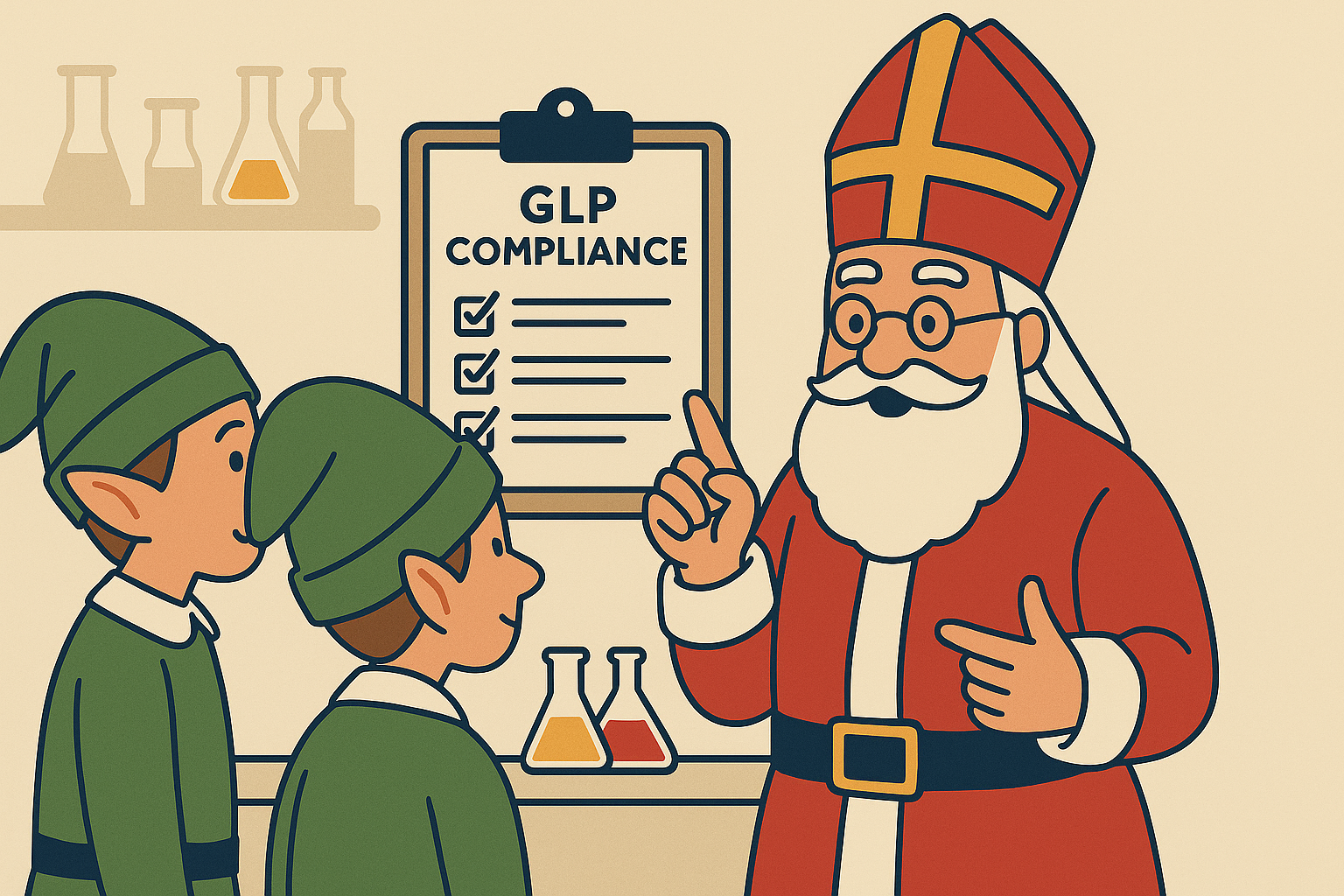
Of course, the lab is fully GLP-compliant:
• GLP according to OECD principles
• FDA 21 CFR Part 58
• EU GMP Annex 11
• “North Pole Food Safety Directive 1347/NIK”
Then came the archiving disaster of 2022.
Chapter 2: The Excel disaster – how a 2.4 GB file almost killed gingerbread approval
4 December 2022, 09:23.
Nicholas opens the legendary file:
Gingerbread_Toxicology_Study_2017_2022_LONGTERM_FINAL.xlsx
File contents:
• 2.4 GB of Excel
• 6 years of toxicology data
• 47,294 individual measurements
• Raw data from 23 analytical instruments
• 1,847 VBA macros
• Chromatograms embedded as images
Nicholas clicks “Open”. Excel responds with: “(Not responding)”
30 minutes later: Bluescreen.
On restart, the bad news: file corrupted, last backup one year old, 12 months of data lost.
Worst timing possible:
The FDA has scheduled an inspection for 5 December – yes, also at the North Pole. The inspectors want complete raw data for the past six years.
Risk scenario:
• No complete GLP raw data
• Gingerbread approval for 2023 in danger
• A world without gingerbread. For anyone.
At this point it’s painfully clear:
Excel is an analysis tool – not a long-term GLP archive.

Chapter 3: biomedion to the rescue – a support call from the North Pole
The lead elf scientist Dr Ruprecht (yes, that Knecht Ruprecht, with a PhD in toxicology) has an idea:
“I know someone. biomedion from Jena. 20+ years of experience in GxP-compliant long-term archiving. If they can handle pharma data, they can save our gingerbread data.”
The emergency call goes out:
“biomedion support, Andreas Suchanek speaking.”
“This is Nicholas. I have an Excel problem and the FDA is coming tomorrow.”
A quick look out of the office window – three reindeer on the parking lot – and the project is on.
Chapter 4: The solution – Watcher instead of Excel monoliths
The biomedion team analyses the NRI environment and sees a textbook case of “what not to do”:
Status quo:
• One 2.4 GB Excel file as “archive”
• No version control
• No audit trail
• Raw data, calculations and macros all in one file
• Proprietary formats from 23 devices
• No validated system
• No long-term migration strategy
Target state:
GxP-compliant, scalable, audit-ready long-term archiving based on Watcher from biomedion.
Implementation – fast, structured, compliant
Within a very short timeframe, the following changes are made:
Instrument integration with Watcher:
• Automatic acquisition of raw data from all 23 instruments (HPLC, GC-MS, LC-MS, UV-Vis, particle counters, …)
• Storage in the original format plus a normalised, long-term readable format
• Full metadata capture for each record (user, time, project, batch, etc.)
• No manual file copying, no copy-paste errors
Archiving architecture:
• Central database for structured study data
• File-based archiving for raw data and chromatograms
• WORM storage for data integrity
• Encryption at rest and in transit
• Geographically redundant backups – including North Pole, Antarctica and Jena
GLP/GxP compliance features:
• Complete audit trails
• Electronic signatures with 2FA
• Validation documentation and SOPs
• Fully aligned with FDA 21 CFR Part 11 and GLP expectations
Legacy data migration:
• Extraction of data from the corrupted Excel file
• Combination with existing backups
• Validation of reconstructed data sets
• Result: 99.7% of data recovered
The remaining 0.3%: duplicates and corrupt cells – no impact on patient/consumer safety or study validity.
Chapter 5: Productivity, space and sanity – the side effects
Besides compliance and sustainability, Nicholas’ lab gains:
1. Massive time savings
o No more long Excel recalculations
o Data available in seconds instead of hours
o ≈ 847 person-hours saved per year (~105 working days)
2. Relaxed FDA inspections
o Raw data, chromatograms, audit trails – all available within seconds
o Outcome: zero findings
Chapter 6: What GLP labs can learn from Nicholas
1. Excel is not a long-term archive
2. GLP/GxP compliance requires validated systems
3. Long-term readability is a strategic topic, not an afterthought
4. Automation reduces error rates and stress
5. Modern cloud or hybrid solutions are often more secure and more sustainable than legacy on-premise setups

Become the Nicholas of your lab
If any of these sound familiar:
• Your Excel files exceed 100 MB
• “_v2_final_really_final.xlsx” is your versioning concept
• You worry about FDA or authority inspections
• Your IT infrastructure burns more energy than necessary
• You spend more time searching for data than analysing it
… then it’s time to talk about GxP-compliant long-term archiving with biomedion.
What biomedion can do for you:
• GxP-compliant long-term archiving (FDA, EMA, OECD, GLP)
• Watcher as central platform for data from instruments and study systems
• Automated data capture and complete audit trail
• Cloud-based or on-premise deployment – depending on your strategy
• Demonstrable CO₂ savings through IT modernisation
Your next step:
Let’s jointly assess how much CO₂, risk and cost you could save by modernising your archiving strategy.
Discover how Watcher can transform your laboratory’s data management – ensuring compliance, security, and efficiency every step of the way.
Merry Nicholas Day, merry Christmas – and may your data always be safe, searchable and audit-ready.